Railing Price Per Running Foot — SS304, SS316 & Glass
Railing price per foot Hyderabad is technical specification guidance for stainless steel, glass and aluminium railing systems from Sun Railings in Jeedimetla, Hyderabad. This page explains system types, running-foot vs square-foot conversion, aluminium options, installation considerations, and the commercial factors that affect a BOQ. All projects are quoted on a drawing-based basis after technical site measurement — contact us for a written project quotation.
Selecting the right railing system starts with three engineering decisions: stainless grade (SS304 inland versus SS316 coastal or pool-adjacent), infill type (bar, cable, glass panel or frameless monolithic), and surface finish (satin, mirror or PVD). Sun Railings engineers review your drawings and site conditions to recommend a compliant IS 875 and IS 2553 assembly for hospitals, hotels, airports, metro stations and high-rise commercial builds.
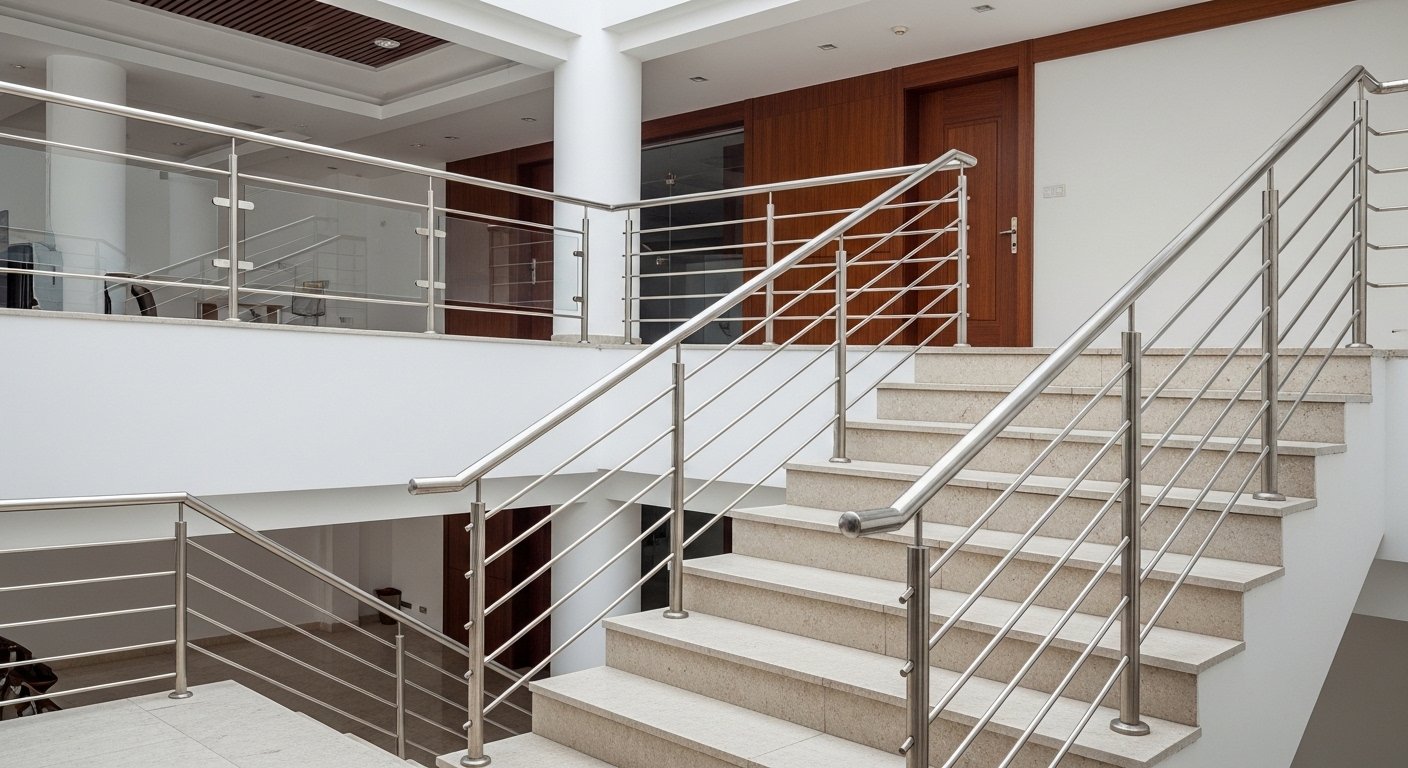
SS pipe and bar systems are typically quoted per running foot; glass systems are usually quoted per square foot
Railing System Types — Quick Reference
Use this section for early scoping. All projects require a drawing-based quotation after site measurement — cost varies based on material grade (SS304 vs SS316), glass thickness, finish, quantity, project size, location, installation complexity and hardware specification. Glass-dominant systems are shown per sq ft because panel area — not only length — drives cost.
| System | Indicative band | Unit |
|---|---|---|
| SS pipe and bar railing | ₹800–₹1,400 | per rft |
| SS and glass infill | ₹800–₹1,400 | per sq.ft |
| Glass railing systems | ₹800–₹1,400 | per sq.ft |
SS Pipe / Bar
drawing-based quotation · typical SS304 · Hyderabad reference
SS + Glass Infill
drawing-based quotation · balustrade-supported hybrid systems
Glass Systems
drawing-based quotation · balustrade-supported to frameless
Note: All costs depend on project specifications, quantity, material grade, hardware selection and installation requirements. GST extra where applicable. IS 875 structural documentation and commercial drawing packs are included on Sun Railings project quotations.
PMC / Developer Next Step
Specify the staircase glass railing system, then request our project catalog
Route your technical parameters straight to our staircase engineering desk—12mm toughened or laminated, top or fascia mounted—to finalize your custom drawing set.
Running Foot vs Square Foot — How Pricing Works
Running foot (rft) measures length along the railing line at a defined height (commonly 900–1,100 mm for balconies and corridors). It is the natural unit for stainless steel pipe, bar, cable and most hybrid post-and-rail systems because height is standardised and cost is driven by posts, top rail and infill length.
Square foot (sq ft) measures length × height and is the natural unit for glass-dominant systems. Taller glass panels use more tempered glass area, thicker sections and heavier hardware — so a per-foot quote without height is incomplete.
Quick conversion
If a glass railing is 1,100 mm high (about 3.6 ft) and 100 rft long, glass area is roughly 360 sq ft. Convert this to a project budget by requesting a drawing-based quotation from Sun Railings — contact us with your measurements and we will provide a written estimate.
Both methods reconcile to the same project total when length, height and inclusions are stated clearly on the BOQ.
Stainless Steel Railing Price Per Foot
Stainless steel railing cost is usually quoted per running foot for bar, pipe and cable systems. The table below shows system types and typical use cases — cost is determined after drawing review and site measurement. Sun Railings fabricates SS304 and SS316 from Jeedimetla for hospitals, hotels, airports, metro stations and high-rise commercial projects across India.
| System | 2026 indicative band | Typical use |
|---|---|---|
| SS304 round/square pipe or bar balustrade | ₹800–₹1,400 per rft | Corridors, service balconies, campuses |
| SS304 post + toughened glass infill | ₹800–₹1,400 per sq.ft | Lobbies, atriums, visible facades |
| SS cable railing with SS posts | ₹800–₹1,400 per rft | Contemporary decks, mezzanines |
| SS316 upgrade (coastal / pool) | Typically +15–20% on SS304 equivalent | Salt spray, pool decks, chemical zones |
| PVD black / gold accent finish | Contact for adder | Hotel branding, feature stairs |
For system selection and commercial applications, see our stainless steel railings product hub. Grade chemistry and exposure rules are covered on the SS304 vs SS316 comparison page.
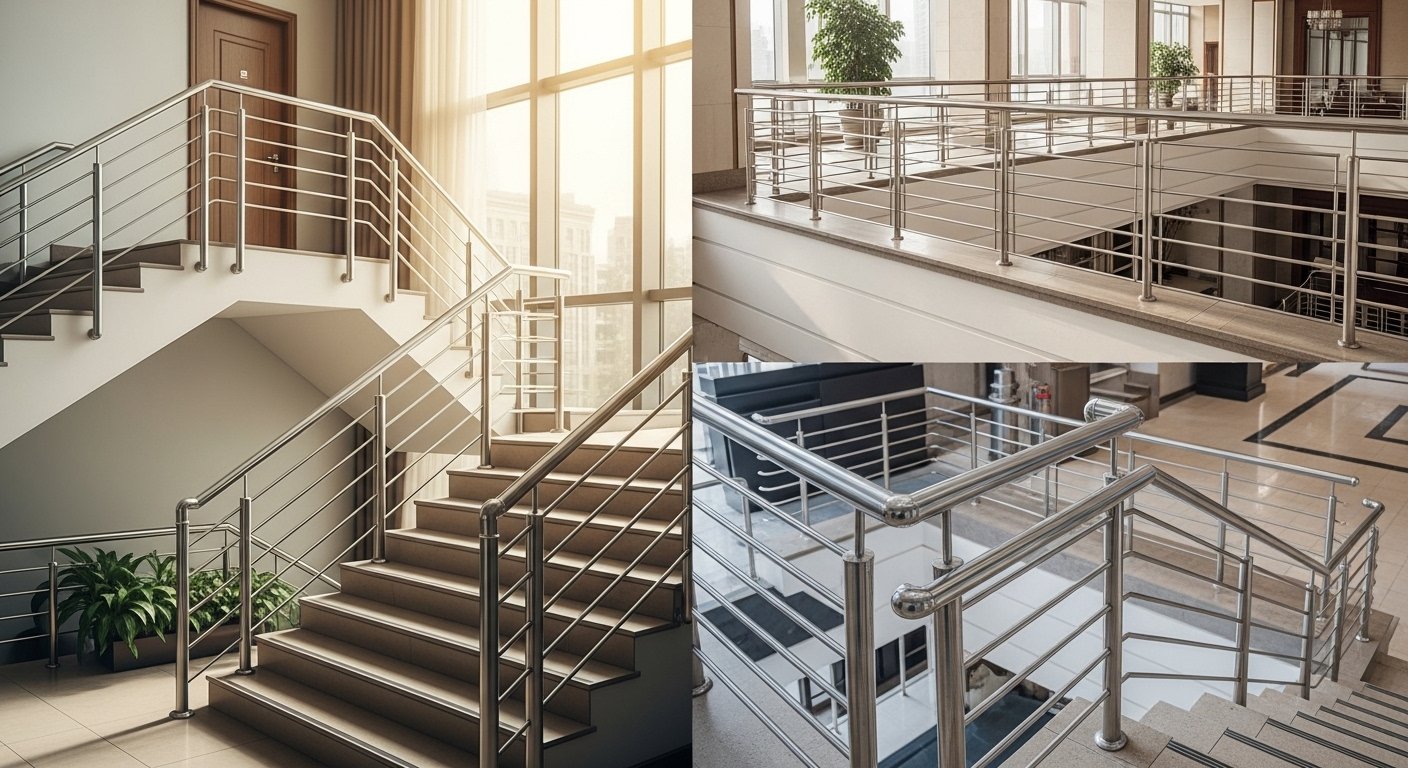
Horizontal bar systems — typically priced per running foot
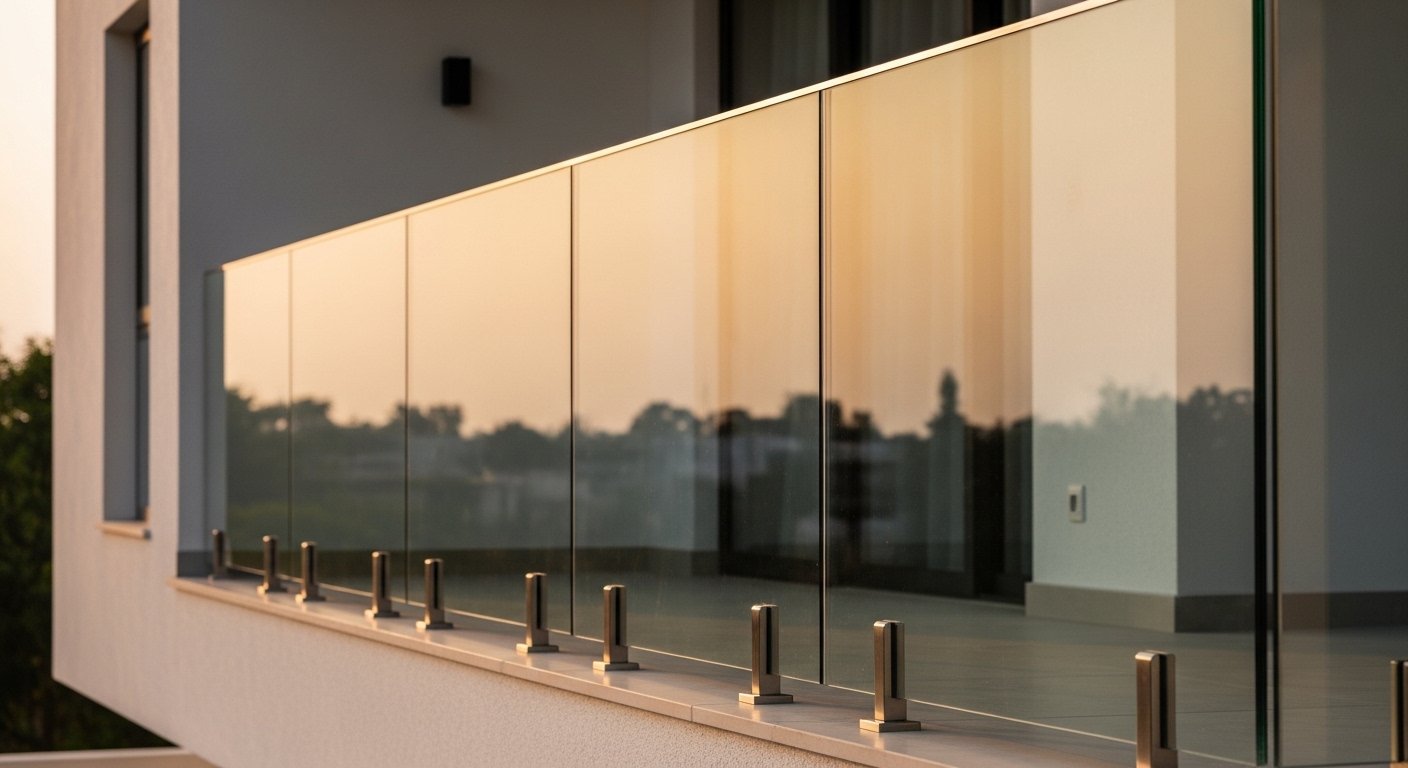
SS post + glass infill — hybrid running-foot or sq-ft BOQs
Glass Railing Price Per Foot (and Per Sq Ft)
Searchers often ask for “glass railing price per foot.” In practice, glass systems are priced per square foot because glass area dominates material cost. Convert to a running-foot budget only after height is fixed. All figures below are relative cost tiers — final glass pricing depends on thickness, hardware and install complexity; contact us for a drawing-based quotation.
| Glass system | Relative cost tier | Notes |
|---|---|---|
| Balustrade-supported glass | Most economical | Most serviceable for high-traffic commercial floors |
| Top-mounted / base shoe | Mid-range | Clean fascia for terraces and galleries |
| Semi-frameless | Mid-range | Balance of transparency and redundancy |
| Channel / spigot frameless | Highest cost tier | Premium sight lines; tighter fabrication tolerances |
Full system tables, thickness notes and Hyderabad commercial context are maintained on the dedicated glass railing price guide. Product variants live on glass railings and frameless glass railings.
Glass vs Stainless Steel Pricing
Choose SS running-foot pricing when
You need durable bar/pipe systems for hospitals, metro concourses, service balconies or long corridors; maintenance access matters; and height is standardised. Cost is dominated by steel tonnage, welding and finish — not glass area.
Choose glass sq-ft pricing when
Sight lines, light and facade presentation drive the brief. Cost is dominated by tempered/laminated glass, channels or spigots, and edge-work tolerances. Frameless assemblies sit at the top of the band.
Many commercial projects mix both: SS bar on service elevations and glass on lobby atriums. Sun Railings quotes mixed scopes on a single drawing set so BOQ units stay consistent per elevation.
SS304 vs SS316 — Price Impact
Grade selection is both a durability decision and a price decision. SS304 (AISI 304) suits most inland Hyderabad commercial work. SS316 (AISI 316) adds molybdenum for chloride and salt-spray resistance — and typically adds about 15–20% (indicative) on material-heavy railing scopes.
| SS304 — typical use | Interior atriums, office towers, hospitals, metro stations inland |
| SS316 — typical use | Coastal facades, pool decks, sea-facing balconies, chemical-adjacent zones |
| Price impact | SS316 typically +15–20% vs equivalent SS304 scope (indicative; quote-dependent) |
| Documentation | Mill test certificates and grade stamps on every Sun Railings dispatch |
Specify grade at drawing stage. Changing from SS304 to SS316 after fabrication starts creates scrap, delay and claim risk. Detailed exposure guidance: SS304 vs SS316 railing.
Aluminium Railing Specification
Aluminium railing systems are often profile-led and may be quoted per running foot for the frame, with glass and installation as separate lines. Cost varies by profile type, bracket configuration, and whether a continuous or concealed system is specified — contact us for a drawing-based quote so aluminium profile, glass thickness and installation method are priced as one package.
Sun Railings supplies aluminium glass railing assemblies for projects that specify aluminium for weight, finish colour range or facade coordination. Ask for a drawing-based quote so aluminium profile, glass thickness and installation method are priced as one package rather than incompatible line items from different vendors.
What Affects Railing Price Per Foot
These buying factors explain most of the spread between a low brochure rate and a commercial BOQ:
- System type — bar/pipe vs glass hybrid vs frameless
- Height and load class — NBC barrier height and IS 875 imposed loads
- Grade — SS304 inland vs SS316 coastal/pool
- Glass specification — 10 mm / 12 mm toughened, laminated where required (IS 2553)
- Finish — satin, mirror polish, PVD coatings
- Building height and wind — post centres, anchorage depth, slab edge conditions
- Access and sequencing — occupied buildings, night work, facade cradles
- Documentation pack — IS 875 calcs, glass certs, GHMC-format drawings (included on Sun Railings commercial scopes)
- Quantity — longer continuous runs improve fabrication efficiency vs fragmented small lots
Labour Cost and Installation Cost
For Hyderabad reference projects, Sun Railings quotations normally bundle fabrication and standard installation into the quoted per-foot or per-sq-ft package. Installation cost still varies with site access and sequencing — so labour is never a single fixed national rate.
Labour intensity rises with frameless spigot layouts, curved runs, night shifts in occupied hospitals/hotels, and high-floor facade access. Those conditions are estimated as discrete installation line items, not buried inside a brochure rate.
Typical adders
| Outstation transport / lodging | Typically ~8–12% (indicative) |
| Complex access / night work | Estimated per elevation |
| Technical site visit | Contact to schedule for Hyderabad and Telangana projects |
Commercial vs Residential Pricing
Commercial / institutional
Expect documentation-heavy scopes: IS 875, NBC notes, mill certificates, mock-ups and phased tower deliveries. Estimated project pricing can look higher than residential DIY quotes because compliance, warranty and multi-elevation logistics are included. Typical buyers: PMC consultants, EPC contractors, hospital and hotel operators.
Residential / small runs
Short balcony runs and villa stairs may show higher per-foot ranges than large commercial packages because setup, travel and fabrication minimums are spread over fewer metres. Always compare inclusions (glass certs, install, scaffolding) — not headline bands alone.
Project Pricing Considerations
Sun Railings has delivered 500+ commercial projects including GMR Airport, L&T Metro, AIIMS Mangalagiri, IIT Hyderabad, IIT Bhilai and IKEA programmes. Pricing for these typologies usually reflects:
Hospitals & healthcare
Satin finishes, corridor continuity, impact-resistant detailing and audit-ready documentation — unit rates reflect compliance more than decorative extras.
Hotels & hospitality
Frameless atriums, PVD accents and pool-deck SS316 drive the upper band; feature stairs are priced separately from standard corridor runs.
Airports & transit
High-traffic balustrade-supported glass, maintainable fixings and phased possession windows affect installation cost more than material unit rates.
IT parks & corporate
Mixed atrium glass and campus walkway SS systems — best quoted as a single multi-elevation package to protect BOQ consistency.
Finishes and Cost Adders
| Satin / brushed (320 grit) | Standard commercial — usually inside base rate |
| Mirror polish | Premium lobbies — higher labour and maintenance |
| PVD titanium (black / gold) | Feature zones — premium over brushed; quoted per project scope |
| Electropolish / passivation | Coastal SS316 — specified for corrosion performance |
Maintenance guidance ships with handover packs. Warranty covers manufacturing and weld integrity; finish damage from chloride cleaners is excluded.
Railing Price Per Foot — FAQs
Request a Technical Site Visit
Share drawings or approximate length and height. Sun Railings returns a drawing-based written quotation for Hyderabad and pan-India commercial scopes — with documentation inclusions and specification assumptions stated upfront.
Plot No. 36, Road No. 80, Phase V, IDA Jeedimetla, Hyderabad, Telangana 500055 · sales@sunrailings.com
Related Guides
Glass Railing Price
Per sq ft system tiers for balustrade-supported, semi-frameless and frameless
Stainless Steel Railings
SS304 and SS316 systems for commercial and infrastructure projects
Glass Railings
Product hub for commercial glass railing systems in Hyderabad
Frameless Glass Railings
Spigot and channel systems for premium commercial entrances
Aluminium Glass Railings
Aluminium-framed glass assemblies for colour-matched facades
Contact / Request Quote
Technical site visit scheduling and drawing-based project quotations