EPC · PMC · Architects · Developers · Institutions
Commercial Railing Manufacturing & Project Delivery Capability
Sun Railings is a commercial and infrastructure project delivery partner — not a catalogue supplier. From engineering review and shop drawings through material procurement, factory fabrication, inspection, logistics, installation coordination and handover, we execute railing packages for developers, EPC contractors, PMC consultants, architects and institutional procurement teams across India. Review our railing manufacturer credentials for company history and delivery footprint.
Cable, Modular & Pricing Packages
Jeedimetla fabrication extends to cable railing systems, modular railing packages, apartment railing systems, glass railing price guides, and commercial barricade systems — all executed from consultant-approved drawings with BOQ-aligned proposals.
How Sun Railings Executes Commercial Railing Programmes
Large commercial towers, hospital campuses, IT parks, metro stations and airport terminals do not fail on product selection — they fail on coordination. Railing packages touch architectural intent, structural interfaces, facade sequencing, interior fit-out milestones and statutory handover. Sun Railings was built to sit inside that coordination chain as a project delivery partner, translating consultant intent into factory-built systems that arrive on site in the right sequence, with the right documentation, at the right construction stage.
Our Jeedimetla manufacturing base supports the full execution stack: engineering review against IFC and architectural issue sets; shop drawing preparation and revision control; material procurement aligned to approved submittals; in-house cutting, bending, welding, glass processing and surface finishing; lot-based quality inspection; dispatch planning tied to EPC programmes; installation support where scoped; and structured project handover for PMC closeout. Whether you are a developer locking a facade package, an EPC contractor managing a transit station, or a PMC consultant auditing subcontractor quality, the engagement model is the same — controlled outputs at every gate.
Explore delivered programmes on our project portfolio, including Hyderabad Metro Rail, Bhogapuram Airport, Microsoft Hyderabad, IIT Bhilai, hospital campuses and IT park developments.
How Sun Railings Delivers Projects
Every commercial railing package follows a nine-stage delivery workflow. Each stage produces contractor-visible outputs so EPC and PMC teams can audit progress without chasing informal updates.
Engineering & Shop Drawing Coordination
Railing is one of the last trades to close a floor — and one of the first a consultant will scrutinize at handover. Sun Railings coordinates shop drawings against the active issue set so site teams are not fabricating from superseded PDFs.
IFC drawings define what must be built on site. We extract railing geometry, bracket locations, glass panel sizes and handrail heights from IFC packages and flag unresolved interfaces before cutting lists are generated.
Architectural drawings control visual intent — finish direction, post spacing, glass type and lobby sightlines. Shop drawings preserve architect intent while adding fabrication tolerances and weld access details the design set may not show.
Structural coordination covers anchor embeds, slab edge reactions, base plate thickness and deflection-sensitive spans on cantilevered stairs or atrium bridges. When structural revisions shift slab levels, railing shop drawings are re-issued before affected lots enter welding.
Technical approvals follow a controlled submittal route: consultant review, comment resolution, re-submittal and approval code on each sheet. PMC teams receive the same register EPC contractors use, simplifying audit.
Drawing revisions during active construction are logged with date, reason and affected lot numbers. Site coordination meetings — virtual or on site — resolve stair core clashes, lift lobby transitions and facade step conditions without informal field changes.
Site coordination includes pre-installation hold points on complex packages: metro platform edges, airport mezzanines, hospital corridor returns and IT park atrium curves where field measurements confirm final shop drawing dimensions.
Material Procurement & System Configuration
Material selection on commercial programmes is a procurement decision, not a sales decision. Grades and finishes are locked on the approved submittal register before purchase orders are released.
Stainless Steel Grades
| Grade | Typical Application |
|---|---|
| SS304 | Commercial buildings, hospitals, IT parks, interior circulation, dry-zone handrails |
| SS316 | Airports, coastal projects, infrastructure, wet zones, exterior exposed locations |
Stainless Steel Finishes
| Finish | Typical Application |
|---|---|
| Satin Finish (#4) | Hospitals, commercial buildings, high-traffic corridors |
| Hairline Finish | architectural projects, corporate lobbies |
| Brushed Finish | Public areas, transit stations, institutional circulation |
| Mirror Finish (8K) | Decorative installations, feature staircases |
| PVD Finish | commercial and hospitality projects |
| Bead Blasted Finish | Contemporary architectural projects, matte feature zones |
PVD Coated Finishes
Physical Vapour Deposition (PVD) coatings are specified when architects require metallic aesthetics without sacrificial maintenance cycles on feature elements. Sun Railings procures and applies PVD finishes under controlled factory conditions so site teams receive consistent colour batches across a campus programme.
Gold PVD — feature handrails, lobby balustrades and hospitality focal stairs where warm metallic tone is part of the interior palette.
Rose Gold PVD — boutique commercial interiors, designer stair cores and high-visibility atrium edges.
Champagne Gold PVD — corporate campuses and institutional lobbies requiring subdued luxury finishes.
Bronze PVD — heritage-adjacent commercial facades and mixed-use podiums with bronze architectural metalwork.
Black Titanium PVD — contemporary tech campuses, auditorium balustrades and contrast handrails on dark stone cladding.
Copper PVD — feature zones where copper tone is required without natural copper patina management on handrail surfaces.
PVD selections are logged on shop drawings with batch references so PMC teams can reconcile visual mock-up approval with delivered lots.
Glass Systems & Safety Configurations
Glass railing on commercial programmes — explore our glass railings and frameless glass railings must be configured for safety performance, replacement access and installation sequencing — especially on atriums, podium edges and transit structures. Sun Railings procures glass to approved thickness configurations and processes panels in-house where the programme requires tight tolerance fit-up.
Toughened glass is used for standard balustrade infill where impact resistance and deflection limits are met by monolithic panels. Laminated toughened glass adds post-breakage retention through PVB interlayers — increasingly specified on public-facing infrastructure and high-occupancy commercial zones.
PVB interlayers in laminated make-ups retain glass fragments after impact, supporting safety objectives on metro stations, airport circulation and hospital atria where downtime from glass replacement is costly.
Glass Thickness Configurations
| Configuration | Typical Thickness |
|---|---|
| Toughened Glass | 12 mm |
| Toughened Glass | 15 mm |
| Laminated Toughened Glass | 13.52 mm (6+1.52 PVB+6) |
| Laminated Toughened Glass | 17.52 mm (8+1.52 PVB+8) |
| Laminated Toughened Glass | 21.52 mm (10+1.52 PVB+10) |
Glass Options
Clear glass, ultra clear (low-iron) glass, frosted glass, acid etched glass, tinted glass and ceramic frit glass are procured to architect selections. Frit patterns on podium edges and skylight adjacencies are increasingly common on IT park and airport packages — panel layouts are shown on shop drawings before glass cutting.
System Types Executed
System type is selected during scope review based on interface complexity, replacement strategy and installation access. Frameless base-shoe packages suit lobbies; post-and-panel systems suit repeatable tower floors; channel systems suit long straight podium runs; staircase glass requires — see staircase glass railings rake-cut panels and aligned handrail bends — each follows the same shop drawing approval gate before glass enters cutting.
Fabrication & Quality Control
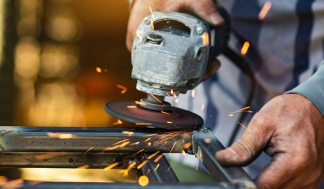
Fabrication at Jeedimetla is organized by lot — not by ad-hoc shop orders. Each lot maps to an approved shop drawing issue, a dispatch milestone and an inspection record.
Cutting — CNC and manual cutting of SS tube, plate and flat bar to drawing dimensions with end-prep for weld access.
Bending — Stair handrail bends, spiral returns and curved atrium rails formed to template or digital bend data from approved geometry.
Welding — TIG and MIG welding by qualified welders with visual and dimensional checks at weld completion hold points.
Surface finishing — Satin, hairline, brushed, mirror, bead blasted and PVD finishes applied in controlled bays to avoid cross-contamination between lots.
Assembly — Posts, handrails, glass shoes, brackets and infill panels assembled into dispatch-ready modules where site access constraints favour pre-assembly.
Packaging — Edge-protected glass crates, SS frame bundling and hardware kits labelled to floor, zone or station package codes.
Quality Checkpoints
Supporting EPC Contractors & PMC Consultants
This is where Sun Railings differentiates from suppliers who only quote per foot. EPC contractors carry programme risk; PMC consultants carry audit risk. Our delivery model produces evidence both sides can use without re-work.
BOQ reviews — We analyse contractor BOQ line items for missing brackets, incorrect unit assumptions, unfinished glass make-up descriptions and hardware omissions. A clarified scope summary reduces variation orders after fabrication release.
Material approvals — Submittal packages include grade certificates, finish samples, glass data sheets and hardware catalogues in PMC-friendly format. Approval codes are mirrored on shop drawings so site inspectors know what was permitted.
Procurement planning — Long-lead glass and PVD finishes are flagged early. Procurement waves align to contractor cash-flow and storage constraints on congested urban sites.
Delivery scheduling — Dispatch calendars integrate with tower completion, station fit-out windows and hospital wing handover dates. Late-night metro possession windows and airport security-controlled deliveries are planned with logistics leads.
Site coordination — Installation supervisors coordinate with civil, facade and MEP trades at lift lobbies, stair cores and podium transitions. Field issues route back through the revision log — not informal WhatsApp sketches.
Documentation support — Inspection records, MTC summaries, packing lists and as-built mark-ups are issued in employer and PMC templates where provided. Third-party inspector access to factory hold points can be arranged on infrastructure packages.
Project Experience
The following programmes illustrate how Sun Railings executes — not what a datasheet specifies. Each engagement involved shop drawing cycles, phased dispatch and handover documentation under EPC or developer direction.
Full portfolio: Commercial railing projects.
Documentation & Project Handover
Handover is not a truck leaving the factory. It is the moment PMC and employer teams can close the railing subcontract with defensible records.
Material test certificates — Mill test certificates for SS grades and third-party glass test reports where specified, indexed to lot numbers on packing lists.
Inspection records — In-process and pre-dispatch checklists with dimensional readings, weld visual acceptance and finish sign-off by lot.
As-built documentation — Marked shop drawing sets showing field-confirmed dimensions on complex returns, stairs and curved segments where as-built was scoped.
Handover documentation — Quantity reconciliation against approved BOQ, outstanding snag list, warranty notes and maintenance guidance for facility teams.
Closeout support — PMC queries on documentation are answered with traceability to approval codes — not verbal assurances. Replacement component identification is logged for facility management after occupancy.
What Is Railing Fabrication?
Railing fabrication is the factory execution of guard, balustrade and handrail systems from consultant-approved shop drawings — CNC tube cutting, TIG/MIG welding, glass slot preparation, surface pickling/passivation, assembly QA, and BOQ-locked dispatch from Jeedimetla, Hyderabad. Sun Railings’ commercial railing fabrication capability covers SS304/SS316 pipe-and-post, SS post-and-glass infill, frameless glass base-channel, and MORTH W-beam crash barrier packages since 2001.
Product lines fabricated: stainless steel railing · SS glass railing · glass railing · frameless glass railing · metal crash barriers.
Railing Fabrication Scope Matrix — Jeedimetla Factory
| Fabrication line | Materials | Standards | Typical output |
|---|---|---|---|
| SS pipe-and-post railing | SS304 / SS316 (IS 6912) | IS 875 · NBC 2016 | Staircase, balcony, atrium guards |
| SS post + glass infill | SS + IS 2553 toughened 12–15 mm | IS 875 · IS 2553 | Tower balcony, lobby balustrades |
| Frameless glass channel | SS316 base shoe / spigot | IS 2553 · IS 16613 | Atrium, podium, feature stairs |
| Highway crash barrier | IS 2062 W-beam / Thrie-beam | MORTH · IS 2629 HDG | NHAI/EPC roadside packages |
Railing Fabrication for Builder, EPC & Infrastructure Projects
Phased Tower & Campus Delivery
- Developer towers — Floor-wise SS and glass railing dispatch aligned to slab cycle; BOQ locked at drawing approval.
- IT parks & hospitals — SS316 wet-zone and atrium packages; see IT park railing and hospital railing.
- Metro & airport — Institutional load-class handrails; Hyderabad Metro Rail project.
- Highway EPC — Crash barrier roll forming and HDG; metal crash barrier fabrication.
Railing Fabrication Documentation for PMC Approval
- Consultant-approved shop drawings and BOQ reconciliation.
- Material MTCs — SS IS 6912, glass IS 2553/IS 16613, steel IS 2062 for crash barriers.
- IS 875 load summary and NBC 2016 guard height confirmation.
- Weld map, method statement, and QC hold-point records from Jeedimetla.
- Phased delivery schedule tied to contractor programme milestones.
Request fabrication BOQ: contact Sun Railings · curved glass railing fabrication · staircase glass railing fabrication.
Related product systems: coastal glass railing fabrication · wet-area pool guard fabrication · emergency egress stair fabrication · industrial fire escape fabrication.
Project Delivery — EPC & PMC Questions
Planning a Fabrication Project?
Submit drawings, BOQ extracts or scope notes. A delivery lead will schedule engineering review and outline the nine-stage workflow for your programme. Commercial and institutional enquiries only.
EPC · PMC · Developer · Architect · Institution